
Friday, August 21, 2026
Capt. Eugene Barker “Red” McDaniel, a decorated U.S. Navy aviator who survived nearly six years as a prisoner of war in North Vietnam and spent the rest of his life advocating for America’s missing servicemembers, died Aug. 7 at his home in the Mount Vernon section of Alexandria. He was 94.
To the public, McDaniel was a war hero. To fellow prisoners, he was something more enduring: a source of strength in the darkest conditions imaginable.
Shot down near Hanoi on May 19, 1967, while flying an A-6 Intruder during the Vietnam War, McDaniel was captured almost immediately and disappeared into the North Vietnamese prison system. For years, his wife Dorothy and children Michael, David and Leslie had little certainty about his fate. The Hanoi government did not acknowledge he was a prisoner until March 1970.
After six years as a POW McDaniel was released on March 4, 1973, following the Vietnam cease-fire.
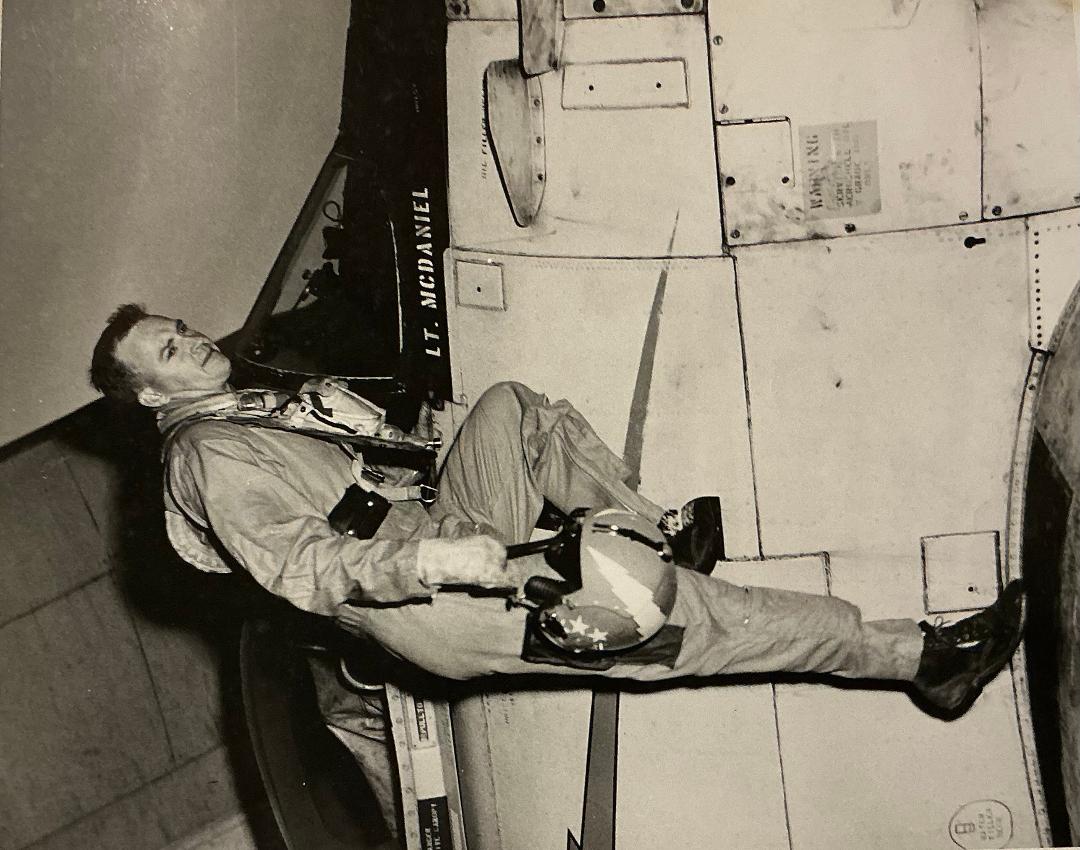 Capt. Eugene McDaniel next to his A-6 Intruder aircraft in Vietnam.
Born Sept. 27, 1931, in Kinston, North Carolina, McDaniel grew up as the eldest of eight children in a family of tobacco sharecroppers. Athletic and ambitious, he attended Campbell Junior College and later Elon College on scholarships. Aviation ultimately proved a stronger calling than athletics, and after entering the Navy he earned his wings as a naval aviator.
By the time he arrived in Vietnam, McDaniel was an experienced officer and pilot. He had flown 81 combat missions before his aircraft was shot down.
What followed became the central chapter of his life story. Fellow POWs and supporters later recalled his willingness to endure punishment and torture while helping sustain the morale of other prisoners. His Christian faith, widely cited by McDaniel himself, became a cornerstone of his survival. Decades later, he would describe faith as the one thing his captors could not take from him.
“Courage is not the absence of fear,” McDaniel said often. “Courage is the presence of faith.”
When he returned home in 1973, McDaniel was awarded the Navy Cross, the Navy’s highest award for valor. His military honors also included two Silver Stars, the Distinguished Flying Cross, the Legion of Merit with Combat “V,” three Bronze Stars with Combat “V” and two Purple Hearts reflecting both combat service and extraordinary courage for injuries suffered during his imprisonment and torture.
“My grandfather was truly a remarkable man with a backstory even Hollywood couldn't dream up,” said McDaniel’s grandson Casey Lindsay. “Despite all the trials and tribulations he faced, he never once wavered in his faith. I often hear the phrase, ‘they don't make 'em like they used to’ and in this instance, I couldn't agree more. He was tough as nails but kind and compassionate and never failed to do what was right. The world would be a better place if we had more men like him.”
Following his release from captivity, McDaniel resumed his Navy career, later commanding USS Niagara Falls and the aircraft carrier USS Lexington. He retired from the Navy in 1982 after serving as a captain and as Navy-Marine Corps liaison to the U.S. House of Representatives.
Following an unsuccessful run for congress in 1982 in North Carolina, with President Ronald Reagan campaigning on his behalf, McDaniel and his wife Dorothy settled in the Mount Vernon section of Alexandria. He authored a book, “Scars and Stripes,” a memoir of captivity, survival and faith. Dorothy McDaniel published her own book, “After the Hero’s Welcome,” detailing her experience as the wife of a POW and advocate for nearly 20 years following her husband’s return.
McDaniel devoted much of his civilian life to public service and advocacy. He founded the American Defense Institute and the American Defense Foundation, organizations focused on promoting a strong national defense. More significantly, he became one of the nation's most persistent voices on behalf of POW/MIA accountability, spending decades seeking answers about Americans who never returned from the Vietnam War. Through his writings, public appearances, and advocacy work, he kept attention focused on the unresolved fate of missing servicemembers, including his bombardier-navigator James Kelly Patterson, and the obligation to account for them.
Still active today, American Defense Institute provides citizen education and leadership training for young Americans. Its POW Awareness Program focuses public attention on American servicemen who are still missing in Southeast Asia.
In 1994, McDaniel helped found Adult Companion Care, (now known as ACCfamily, Inc.) after his own struggles to find quality home care for a family member. Headquartered in Alexandria, ACCfamily is a senior home care agency whose vision is to allow people to stay in their homes for as long as they desire. It now serves seniors throughout Northern Virginia and southern Maryland.
In December of 2023, McDaniel and fellow Alexandria resident and Medal of Honor recipient Col. Paris Davis were honored by Governor Glenn Younkin as the Virginia Veterans Care Center in Roanoke was renamed the Davis and McDaniel Veterans Care Center. In 2019, McDaniel was named a Living Legend of Alexandria.
McDaniel is survived by his wife of 70 years, Dorothy Howard McDaniel of Alexandria, their children Capt. Michael Howard McDaniel (USN ret), and Leslie McDaniel Lindsay, both of Alexandria, and David Eugene McDaniel of San Diego, Calif. He is also survived by nine grandchildren and eight great-grandchildren.
A celebration of Life will be held Aug. 22 at 1 p.m. at Alexandria Presbyterian Church, 1300 West Braddock Road, Alexandria, VA 22302.
Donations may be made in lieu of flowers to the American Defense Institute (ADI), 9316 Craig Ave, Alexandria, VA 22309.
For many Americans, “Red” McDaniel became part of a generation of Vietnam-era servicemembers whose courage was tested not only in combat but in years of imprisonment. His life bridged the tobacco fields of North Carolina, the flight decks of Cold War aircraft carriers, the cells of the Hanoi Hilton, and a long campaign to remember those who never returned home.
“Captain McDaniel, thank you for loving our country,” Youngkin said at the VA renaming dedication. “Thank you for demonstrating what selfless service means. And thank you for reminding all of us that freedom is not free.”
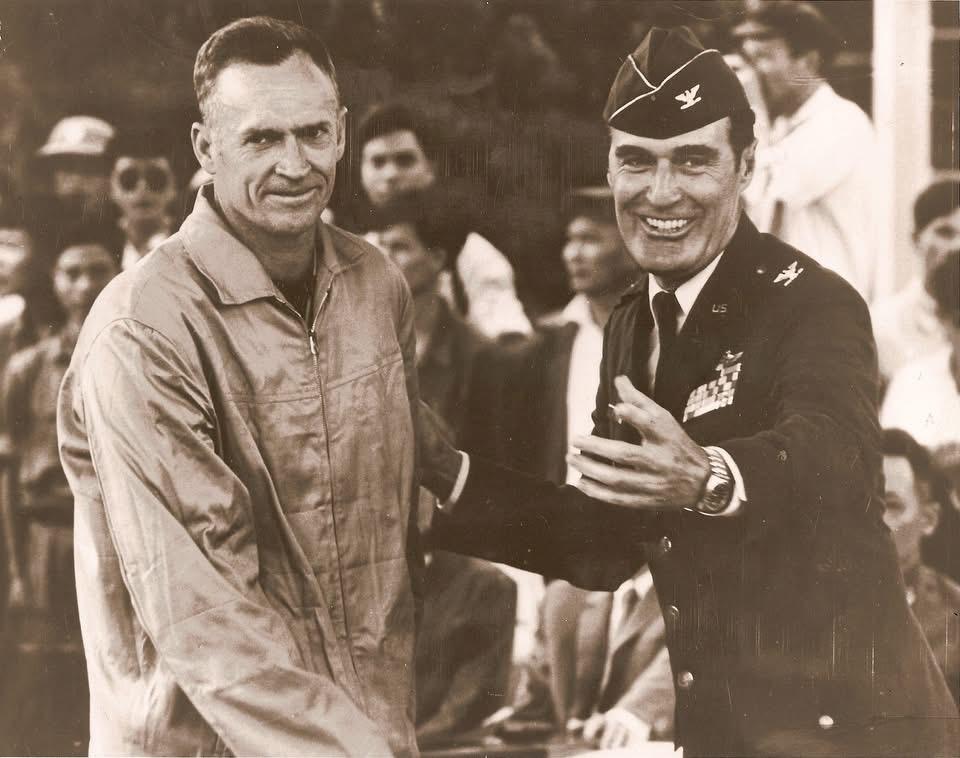 Capt. Eugene McDaniel, left, being released from captivity in Hanoi in March of 1973.